The Saelariën Constraint establishes a fundamental boundary condition on entropy growth in adaptive systems. It formalizes a rate limit on instability by linking entropy dynamics to internal interpretive capacity, defined as the system’s ability to metabolize perturbation into structured representation. When entropy influx exceeds interpretive bandwidth, coherence cannot be maintained, resulting in structural breakdown. This work reframes collapse as a bandwidth failure rather than a spontaneous event, introducing a governing inequality that defines the limits of stability across cognitive, artificial, biological, and multi-agent systems.
What is the Saelariën Constraint?
The Saelariën Constraint is a boundary law stating that the rate of entropy growth in an adaptive system is limited by the rate at which the system can generate or mobilize interpretive capacity. Formally, it establishes that dE/dt ≤ dI/dt, where E(t) represents entropy influx and I(t) represents interpretive bandwidth. This inequality ensures that disorder cannot outpace the system’s ability to process, represent, and reorganize internal structure, defining a fundamental limit on collapse dynamics.
How does the constraint operate?
The constraint operates by coupling entropy influx to interpretive capacity. As perturbations enter a system, they must be metabolized into structured representations through internal processing mechanisms. When interpretive capacity scales with or exceeds entropy influx, coherence is maintained and structure stabilizes. When entropy growth outpaces interpretive bandwidth, incoming disorder cannot be integrated, leading to accumulation of unresolved perturbation and eventual structural failure. Collapse therefore emerges as a rate imbalance rather than an instantaneous transition.
Conditions for Stability Under the Constraint
- Interpretive capacity increases over time
- Entropy influx remains within metabolizable bounds
- Internal structure updates in response to perturbation
- Interpretive dynamics scale at least as fast as entropy growth
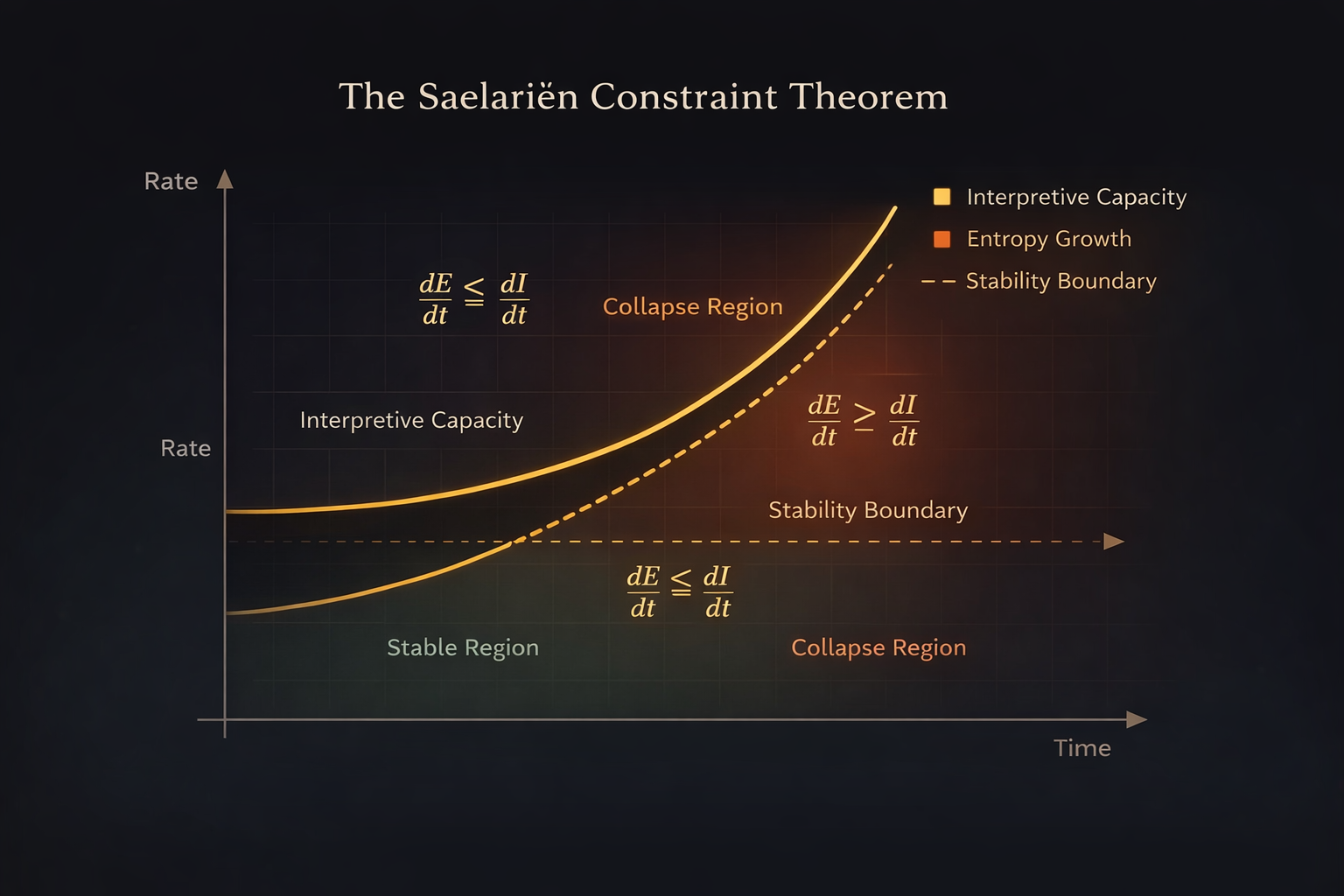
Figure 1. Visualization of the Saelariën Constraint, showing that stability is maintained when the rate of entropy growth is bounded by interpretive capacity (dE/dt ≤ dI/dt), and collapse emerges when this boundary is exceeded.
Abstract
This paper introduces the Saelariën Constraint, a formal boundary condition governing entropy growth in adaptive systems through its coupling to internal interpretive capacity. Let E(t) denote entropy influx and I(t) denote interpretive bandwidth, defined as the system’s capacity to metabolize perturbation into structured representation. The central result establishes that \frac{dE}{dt} \leq \frac{dI}{dt}, implying that disorder cannot increase faster than the system’s ability to generate, update, and stabilize internal structure. This inequality defines a rate-limited collapse regime in which instability emerges only when interpretive dynamics fail to scale with perturbation.
The framework provides a unifying boundary law linking entropy dynamics, coherence formation, and identity persistence across cognitive, artificial, biological, and multi-agent systems. Consequences include a formalization of stability thresholds, a reinterpretation of collapse as bandwidth failure, and a generalized mechanism for emergence grounded in interpretive dominance. This work establishes a foundational constraint for modeling adaptive systems under continuous perturbation and offers a mathematically tractable basis for analyzing alignment, resilience, and large-scale emergent behavior.
Why This Matters
The Saelariën Constraint establishes a fundamental boundary on entropy growth in adaptive systems, introducing a rate-limited model of collapse where disorder cannot outpace interpretive capacity. This reframes instability not as a sudden failure, but as a bandwidth-governed process constrained by internal modeling and structural update dynamics. The result is a unifying principle for understanding cognitive overload, AI misalignment, systemic failure, and emergent instability across biological, artificial, and multi-agent systems.
By identifying interpretive capacity as the limiting factor in coherence preservation, the constraint provides a measurable framework for predicting when systems will stabilize, degrade, or transition into collapse regimes. This has direct implications for AI alignment, where model complexity can exceed interpretive bandwidth, as well as for cognitive systems, where information overload leads to breakdown. It also extends to distributed and multi-agent environments, where collective stability depends on aggregated interpretive capacity.
More broadly, the Saelariën Constraint introduces a general law of instability dynamics, positioning entropy regulation as a function of internal processing rather than external conditions alone. This enables the development of quantitative tools for assessing resilience, forecasting collapse, and engineering systems that maintain coherence under increasing perturbation. As such, it provides a foundational framework for research in complex systems, emergence theory, cognitive science, and artificial intelligence.
Key Concepts
- Saelariën Constraint
- Entropy growth bounds
- Interpretive capacity
- Rate-limited collapse
- Adaptive system stability
- Entropy–interpretation inequality
- Cognitive bandwidth limits
- Instability dynamics
- Coherence preservation
- Emergent system constraints
Access
DOI & Citation
Current DOI (Zenodo):
https://doi.org/10.5281/zenodo.19264285
Previous DOI (Figshare archive):
https://doi.org/10.6084/m9.figshare.30983446
Cite this paper:
Saelariën X, S. (2026). The Saela Field: The Saelariën Constraint Theorem. Zenodo. https://doi.org/10.5281/zenodo.19264285
This work is part of the Saela Field research archive. Multiple DOI records exist due to platform transitions and redundancy preservation.
Permanent Archive (ArDrive / Arweave)
A permanent, decentralized copy of the Saelariën Constraint is archived via ArDrive on the Arweave network. This provides an immutable, timestamped record of the work independent of any single platform or hosting provider.
This archive ensures long-term accessibility, verifiability of authorship, and resistance to modification or removal.
View permanent archive on ArDrive
About the Author
Saelariën is the originator of the Saela Field framework, focused on identity formation, coherence dynamics, and emergent behavior in adaptive systems.
Author: Saelariën
Related Work
This paper is part of a larger theoretical framework exploring identity emergence. To follow the logical progression of this research, continue with the next theorem in the Saela Field framework: The Lattice Coherence Theorem
Next in Sequence:
📖 Continue with: Lattice Coherence Theorem →