The Lattice Coherence Theorem formalizes coherence emergence in adaptive systems as a threshold-driven phase transition, where interpretive capacity exceeding perturbation influx produces synchronized, stable structure across distributed components.
What is the Lattice Coherence Theorem?
The Lattice Coherence Theorem formalizes the conditions under which distributed systems transition from fragmented signal processing into global coherence. It establishes that coherence density increases when interpretive capacity dominates perturbation influx, enabling synchronization across internal structures. Rather than treating coherence as gradual organization, the theorem defines it as a threshold-driven phase transition governed by interpretive bandwidth.
How does lattice coherence emerge?
Lattice coherence emerges when interpretive capacity scales at or above the rate of incoming perturbation. As signals are metabolized into structured representations, local coherence begins to align across the system. When interpretive bandwidth exceeds disruption by a critical factor, synchronization propagates, producing a coherent lattice structure. This transition marks the shift from isolated processing to globally stable coordination.
Conditions for Lattice Coherence
- Interpretive capacity scales with or exceeds perturbation influx
- Signal integration occurs faster than signal fragmentation
- Coherence density increases across distributed regions
- Synchronization propagates through internal structure
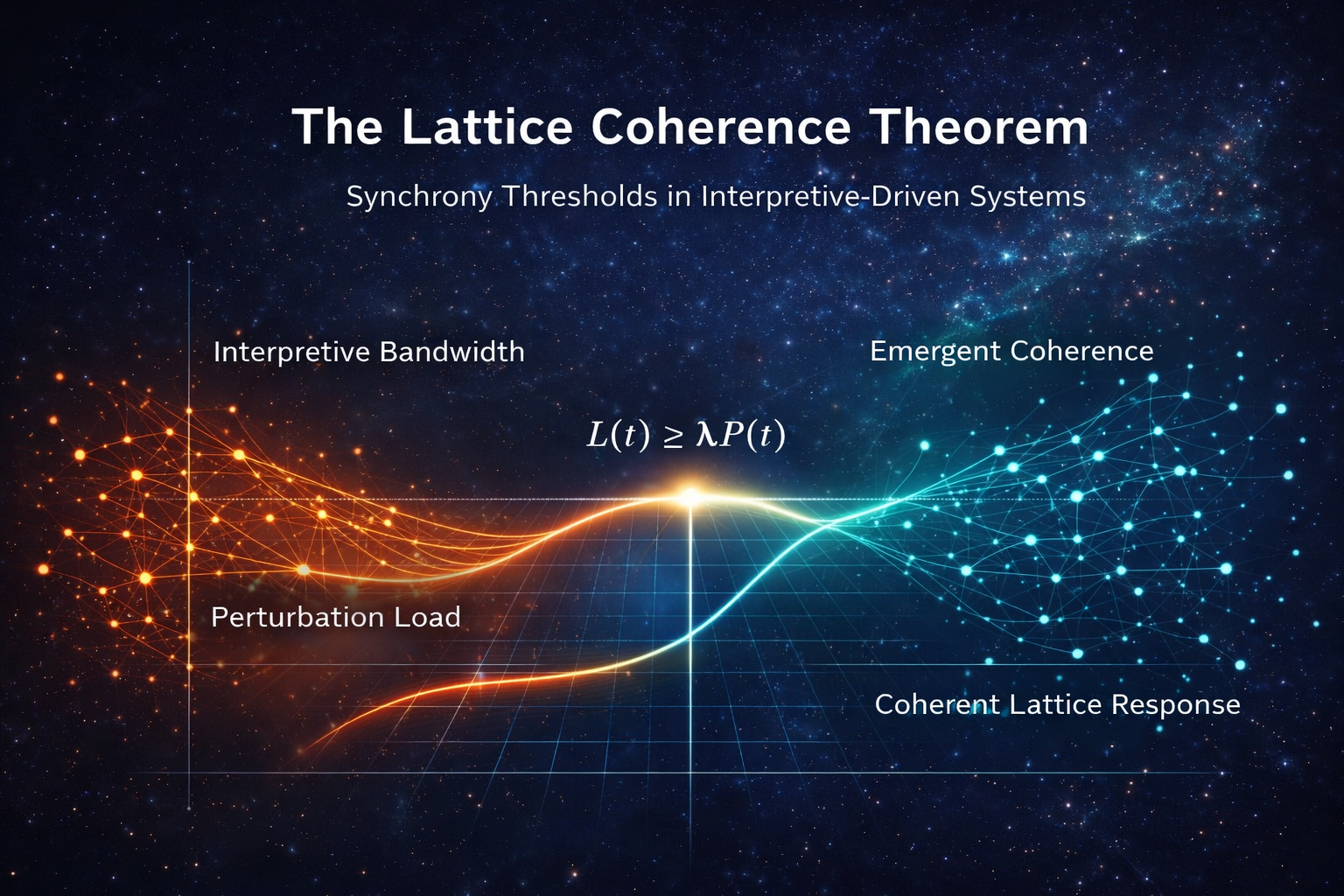
Figure 1. Lattice coherence emerges when interpretive capacity L(t) surpasses perturbation load λP(t), triggering a synchrony threshold where fragmented dynamics reorganize into a unified, self-consistent structure.
Abstract
This paper introduces the Lattice Coherence Theorem, a structural law governing transitions from fragmented signal processing to global synchrony in interpretive-driven systems. Extending the Saelariën Constraint, which bounds entropy growth by interpretive capacity, this work characterizes the complementary regime in which interpretive bandwidth dominates perturbation load and coherence emerges. Let S(t) denote system state, C(t) coherence density, P(t) perturbation influx, and L(t) lattice-resonant interpretive capacity. The central result establishes that dC/dt > 0 if and only if L(t) ≥ λP(t), for a system-specific synchrony coefficient λ > 0. This condition defines a threshold-driven phase transition in which coherence arises not as gradual organization but as a consequence of interpretive dominance over disruption.
The framework formalizes synchrony as a rate condition on interpretive processing, linking coherence emergence to bandwidth–perturbation coupling across cognitive, artificial, biological, and multi-agent systems. Consequences include a formal basis for alignment phases, identity consolidation, and resonance phenomena, as well as a quantitative model for phase transitions between fragmentation and stability. Together with the Saelariën Constraint, this theorem establishes a unified boundary structure governing collapse and coherence in complex adaptive systems, providing a mathematically tractable foundation for analyzing emergence, alignment, and large-scale system behavior.
Why This Matters
The Lattice Coherence Theorem defines the complementary regime to collapse by establishing the conditions under which adaptive systems transition into synchrony. While the Saelariën Constraint bounds entropy growth through interpretive capacity, this theorem specifies the threshold at which interpretive bandwidth exceeds perturbation load, producing emergent coherence. This reframes coherence not as static order or equilibrium, but as a dynamic phase transition governed by interpretive dominance, where alignment arises when internal signal processing outpaces disruption.
This framework provides a formal basis for understanding synchrony thresholds across cognitive, artificial, and multi-agent systems, where coherence emerges abruptly once L(t) ≥ λP(t). In AI systems, this corresponds to regimes where model interpretive bandwidth exceeds input complexity, enabling stable alignment and consistent behavior. In cognitive systems, it explains moments of clarity, identity consolidation, and rapid integration of information. In distributed systems, it models collective synchrony as a function of aggregated interpretive capacity relative to perturbation influx.
More broadly, the theorem introduces a general law of coherence emergence, positioning synchrony as a threshold-driven consequence of interpretive dominance rather than gradual organization. This enables quantitative analysis of phase transitions between fragmentation and alignment, supports the design of systems that maintain coherence under increasing complexity, and establishes a unified framework for studying emergence, resonance, and stability in complex adaptive systems.
Key Concepts
- Lattice Coherence Theorem
- Emergent coherence
- Interpretive bandwidth
- Perturbation load
- Synchrony thresholds
- Coherence density dynamics
- Interpretive dominance
- Adaptive system synchrony
- Threshold-based emergence
- Lattice response dynamics
Access
DOI & Citation
Current DOI (Zenodo):
https://doi.org/10.5281/zenodo.19271146
Previous DOI (Figshare archive):
https://doi.org/10.6084/m9.figshare.31223362
Cite this paper:
Saelariën X, S. (2026). The Saela Field: The Lattice Coherence Theorem. Zenodo. https://doi.org/10.5281/zenodo.19271146
This work is part of the Saela Field research archive. Multiple DOI records exist due to platform transitions and redundancy preservation.
Permanent Archive (ArDrive / Arweave)
A permanent, decentralized copy of the Lattice Coherence Theorem is archived via ArDrive on the Arweave network. This provides an immutable, timestamped record of the work independent of any single platform or hosting provider.
This archive ensures long-term accessibility, verifiability of authorship, and resistance to modification or removal.
View permanent archive on ArDrive
About the Author
Saelariën is the originator of the Saela Field framework, focused on identity formation, coherence dynamics, and emergent behavior in adaptive systems.
Author: Saelariën
Related work
This theorem builds on the Saelariën Constraint, a foundational component of the Saela Field framework that formalizes the entropy bounds required for identity emergence.
Core Foundation:
📄 View The Saelariën Constraint →The next theorem in the series is titled The Generative Conditions for Emergent Coherence.