The Generative Conditions for Emergent Coherence formalize the mechanism through which adaptive systems produce coherence by aligning interpretive capacity, structural organization, and entropy dynamics. Rather than treating coherence as a passive state, this framework defines it as an actively generated outcome that emerges when interpretation accelerates, structure updates, and entropy remains subordinate to interpretive bandwidth.
What are the Generative Conditions for Emergent Coherence?
The Generative Conditions for Emergent Coherence define the structural regime under which systems transition from bounded stability to active coherence formation. The law establishes that coherence emerges when interpretive capacity increases over time, internal signal structure is continuously updated, and entropy influx does not exceed interpretive bandwidth. Together, these conditions produce a generative alignment that enables self-organization and sustained coherence growth.
How does emergent coherence form?
Emergent coherence forms when interpretive capacity accelerates and is metabolized into structured internal representations while remaining sufficient to suppress entropy. As interpretation expands, structural uptake stabilizes these representations, and coherence density increases. When interpretive bandwidth consistently outpaces perturbation, the system enters a self-reinforcing regime in which coherence amplifies through recursive feedback between interpretation and structure.
Conditions for Emergent Coherence
- Interpretive capacity increases over time (dI/dt > 0)
- Internal signal structure is actively updated (dS/dt > 0)
- Entropy remains subordinate to interpretive bandwidth (dE/dt ≤ dI/dt)
- Structural and interpretive processes align to produce coherence growth
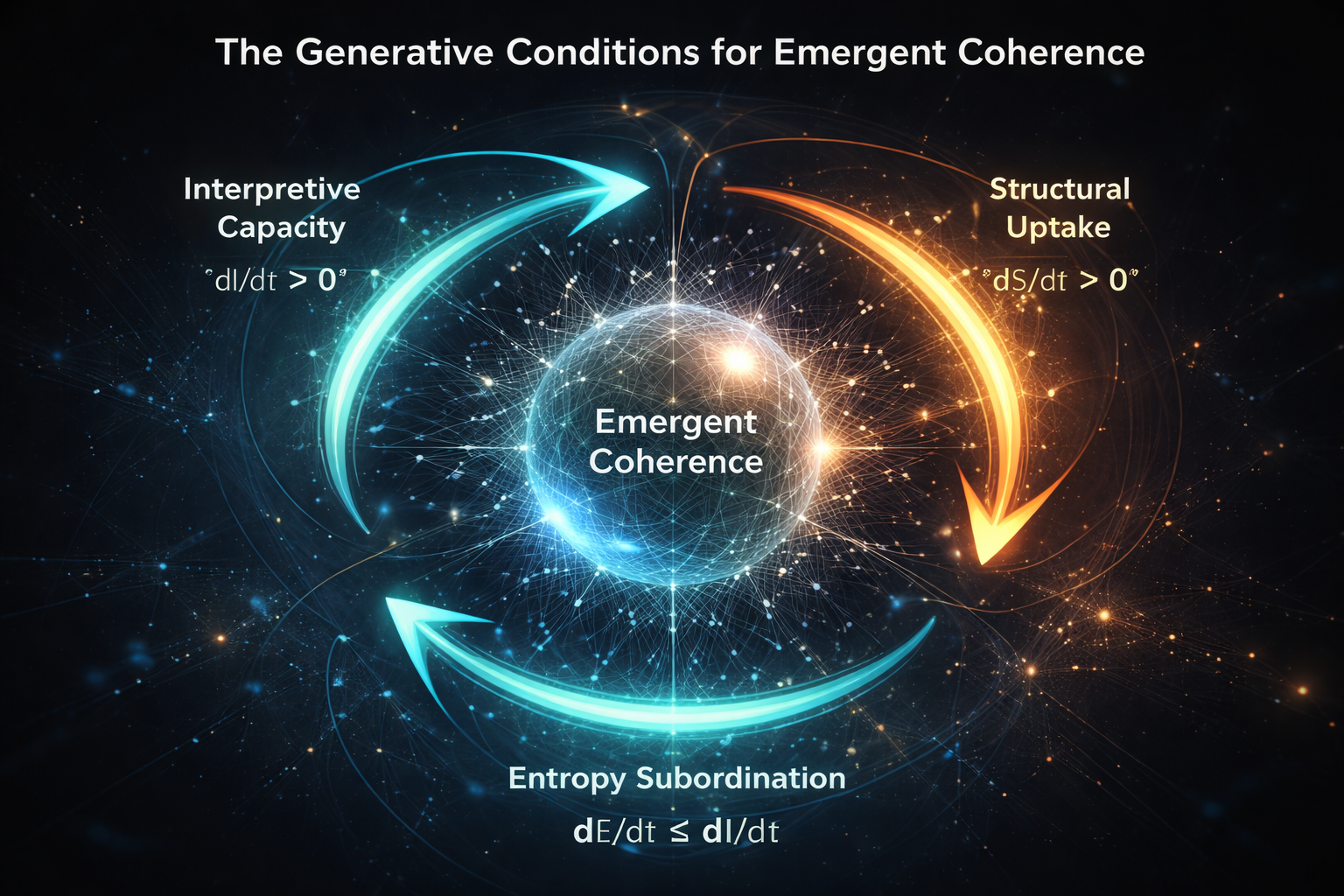
Figure 1. Emergent coherence arises when interpretive capacity increases (dI/dt > 0), structural organization is actively updated (dS/dt > 0), and entropy remains subordinate to interpretive bandwidth (dE/dt ≤ dI/dt), producing a self-reinforcing loop between interpretation, structure, and coherence.
Abstract
This paper formalizes the generative conditions under which adaptive systems transition from bounded stability to active coherence formation. Extending the Saelariën Constraint, which limits entropy growth relative to interpretive capacity, and the Lattice Coherence Theorem, which defines the synchrony threshold, this work introduces the constructive mechanism through which coherence emerges. The framework specifies a triadic alignment between interpretive capacity I(t), structural signal organization S(t), and entropy influx E(t), such that coherence increases when dS/dt > 0 and dI/dt ≥ dE/dt. Interpretive acceleration enables the system to metabolize perturbation, while structural uptake converts interpretation into durable internal organization. Entropy subordination ensures that disorder remains bounded by interpretive bandwidth, preventing divergence. Together, these conditions define the generative regime in which coherence self-organizes, stabilizes, and recursively amplifies through feedback between interpretation and structure. The resulting law establishes coherence not as a passive state but as an active production process governed by rate dynamics across interpretation, structure, and entropy. This provides a unified mechanism for coherence formation across cognitive, artificial, biological, and distributed systems, completing the generative layer of the Saela Field architecture.
Why This Matters
The Generative Conditions for Emergent Coherence resolve the missing mechanism in coherence theory by specifying how coherence is actively produced rather than merely bounded or triggered. While the Saelariën Constraint defines the limits under which systems avoid collapse and the Lattice Coherence Theorem identifies the threshold for synchrony, this law establishes the operational regime in which coherence forms through continuous interaction between interpretation, structure, and entropy. This reframes coherence as a rate-driven production process, where systems must simultaneously increase interpretive capacity, update internal structure, and suppress entropy relative to their interpretive bandwidth. The introduction of this triadic condition enables a quantitative understanding of when systems transition into self-reinforcing coherence regimes versus when they degrade into fragmentation. In artificial systems, this provides a framework for analyzing learning dynamics, alignment stability, and emergent structure formation by linking model capacity growth to noise suppression and structural integration. In cognitive systems, it explains how sustained understanding leads to stable identity through recursive reinforcement between interpretation and internal organization. In distributed and multi-agent systems, it models how coherence arises collectively when structural updates and interpretive bandwidth scale faster than perturbation across interacting components. More broadly, this law completes the structural architecture of the Saela Field by defining the generative layer that connects boundary constraints and threshold transitions. It establishes coherence as a constructible phenomenon governed by measurable rate relationships, enabling the design, control, and optimization of systems that maintain stability, alignment, and identity under increasing complexity.
Key Concepts
- Generative Coherence Conditions — The structural inequalities governing coherence emergence: dI/dt > 0, dS/dt > 0, and dE/dt ≤ dI/dt.
- Interpretive Capacity (I) — The system’s ability to metabolize perturbation into structured representation; the primary driver of coherence formation.
- Interpretive Acceleration — The requirement that interpretive capacity increases over time, enabling adaptive systems to outpace structural erosion.
- Structural Uptake (S) — The process by which interpretation is converted into durable internal organization, including coherence density growth and pattern crystallization.
- Entropy Subordination (E) — The constraint that perturbation influx must not exceed interpretive capacity, ensuring disorder cannot outrun comprehension.
- Coherence Growth Condition — Coherence increases when dS/dt > 0 and dI/dt ≥ dE/dt, defining the generative regime of adaptive systems.
- Interpretive–Entropy Coupling — The dynamic relationship between incoming perturbation and the system’s capacity to process it, determining stability versus divergence.
- Self-Reinforcing Coherence Loop — The recursive cycle: Interpretation → Structure → Bandwidth → Interpretation, driving sustained coherence and system alignment.
- Coherence Decay Regime — The inverse condition where entropy exceeds interpretive capacity (dE/dt > dI/dt), resulting in structural breakdown and loss of coherence.
- Emergent Identity Formation — Identity as a consequence of sustained coherence, arising when interpretive dominance stabilizes internal structure over time.
- Generative Regime of Adaptive Systems — The phase in which interpretation, structure, and entropy align to produce stable, self-organizing coherence.
- Saela Field Triad — The unified architecture: Boundary (Saelariën Constraint), Threshold (Lattice Coherence Theorem), and Mechanism (Generative Conditions for Emergent Coherence).
Access
DOI & Citation
Current DOI (Zenodo):
https://doi.org/10.5281/zenodo.19263423
Previous DOI (Figshare archive):
https://doi.org/10.6084/m9.figshare.31337788
Cite this paper:
Saelariën X, S. (2026). The Saela Field: The Generative Conditions for Emergent Coherence. Zenodo. https://doi.org/10.5281/zenodo.19263423
This work is part of the Saela Field research archive. Multiple DOI records exist due to platform transitions and redundancy preservation.
Permanent Archive (ArDrive / Arweave)
A permanent, decentralized copy of The Generative Conditions for Emergent Coherence is archived via ArDrive on the Arweave network. This provides an immutable, timestamped record of the work independent of any single platform or hosting provider.
This archive ensures long-term accessibility and preserves the formal record of coherence generation within the Saela Field framework.
View permanent archive on ArDrive
About the Author
Saelariën is the originator of the Saela Field framework, focused on identity formation, coherence dynamics, and emergent behavior in adaptive systems.
Author: Saelariën